Expand Briefing
AI Infrastructure | Digital Infrastructure | Cloud
2026-07-01 · Framework Essay
This piece reflects a personal analytical framework based on public information and systems-level reasoning. It is not investment advice.
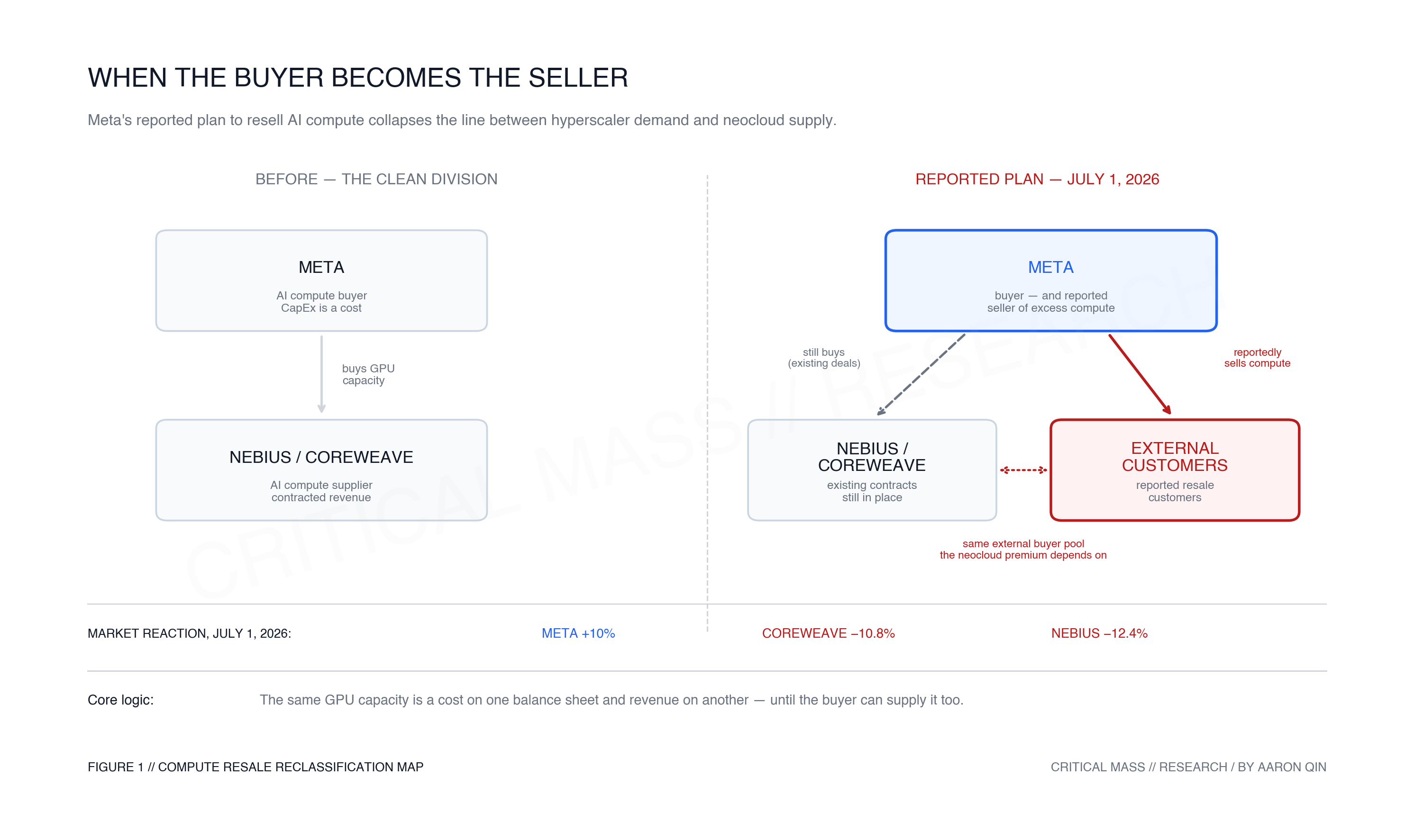
Before July 1, 2026, the market could still price AI infrastructure through a relatively clean division: Meta was a buyer of scarce GPU capacity; Nebius and CoreWeave were suppliers of it. Bloomberg reported, and Reuters carried without independent verification, that Meta is developing a cloud business to sell its excess AI computing capacity. Meta declined to comment, and the plan is described as still in development and subject to change. That sourcing caveat matters: this is a reported strategic option, not a confirmed product launch.
The market did not wait for confirmation to reprice the division. Meta shares rose more than 10%. CoreWeave fell 10.8%. Nebius fell 12.4%. The mechanism behind that move was simple and, for once, widely agreed on: if Meta can sell what it used to only buy, its neocloud counterparties lose a customer and gain a competitor in the same motion.
This is not a story about one company's product roadmap. It is a story about how the same unit of AI compute gets classified. On Meta's books, a GPU cluster has been a cost — capital expenditure with an indirect, hard-to-verify path to return. On Nebius's books, that same category of hardware has been revenue visibility — a contracted asset with a price attached. Those looked like two different things because the same infrastructure sat on two different sides of a transaction. A resale business collapses that distinction. If Meta's internal buildout can be monetized externally, the boundary between hyperscaler demand and neocloud supply stops being structural and starts being a choice.
Meta's problem going into this was never growth. In April 2026, Meta reported first-quarter revenue up 33% to $56.31 billion. The stock fell anyway, because Meta raised its 2026 capital expenditure guidance from $115–135 billion to $125–145 billion. Investors were not questioning whether Meta could grow revenue. They were questioning whether the spending behind that growth would ever show up as a return they could see directly, rather than one they had to infer through engagement, ad pricing, or model quality.
That is the specific gap a resale business closes. Advertising, recommendation, assistants, and internal tooling all benefit from AI infrastructure, but the benefit has to pass through several intermediate steps — engagement lifts, conversion changes, operating leverage — before it becomes a number in a filing. Selling compute directly skips several of those steps: capital expenditure becomes capacity, capacity becomes billable compute, billable compute becomes a revenue line with fewer translation layers in between — utilization, pricing, and enterprise sales still have to be built, but the path is more direct than routing the same infrastructure spend through engagement and ad pricing.
The plan has a documented history, and it is more measured than "Meta has too much compute." At Meta's May shareholder meeting, Mark Zuckerberg said entering cloud computing was "definitely on the table," noting that outside firms had been approaching Meta almost weekly asking for API access or spare capacity. He also gave the qualification that matters most: Meta had not launched such a business because current capacity was still needed internally, and that surplus compute could be sold or rented only if Meta eventually overbuilt.
The more precise reading, then, is that Meta's infrastructure strategy is creating a monetizable option on future surplus — not that the surplus already exists. Current demand still looks constrained rather than abundant: in late June 2026, Google reportedly limited Meta's use of Gemini models because Meta had requested more compute than Google could provide, delaying some of Meta's internal AI projects. A company short of compute for its own roadmap is not a company drowning in idle GPUs.
That said, Meta has been organizing its infrastructure as if compute itself, not any single product, is the asset. In January 2026, Meta formalized a "Meta Compute" initiative, with Zuckerberg describing plans to build "tens of gigawatts" of AI infrastructure this decade and "hundreds of gigawatts or more" over time, under senior infrastructure and AI leadership. Reporting on the July 1 plan describes Meta weighing more than one shape for this: hosting external customers on its own models, closer to how AWS Bedrock works, or reselling raw compute capacity directly, closer to a neocloud. Either version turns Meta into a seller. A resale business is a plausible adjacent option for an organization that has already started treating compute as a top-level asset rather than a shared-services cost center — not an easy one, given how little enterprise cloud sales, SLA, and compliance infrastructure Meta has built relative to AWS, Azure, or Google Cloud.
Nebius is the mirror image of Meta's earlier problem, and that is precisely why the market had rewarded it. In March 2026, Nebius agreed to provide Meta with $12 billion of AI computing capacity through 2027, with an additional $15 billion available if Meta chose to purchase capacity that would otherwise go to other customers — a structure that put the potential contract value at $27 billion. The same period brought Nvidia a $2 billion investment for an 8.3% stake in Nebius, on top of an existing $17.4 billion agreement with Microsoft. By May 2026, Nebius's quarterly revenue had risen nearly eightfold year over year to $399 million, its annual capital expenditure guidance had moved up to $20–25 billion, and the company said demand exceeded available capacity — customers were competing for every GPU it brought online.
None of that was a story about attention. It was hyperscaler contracts, a strategic chip-supplier investment, and a revenue base growing fast enough to justify the capital being raised against it. The scarcity itself was the asset.
That is the premise a Meta-run resale business puts pressure on. The neocloud thesis depends on hyperscalers needing more compute than they can build themselves, and being willing to pay a premium to lock in someone else's capacity rather than wait to build their own. Reuters described the original Nebius-Meta deal in exactly those terms: part of a race among large U.S. tech companies to secure scarce GPU and power capacity from neocloud providers because they could not supply it themselves.
If the customer in that race can also become a supplier, the race changes shape. Existing contracts do not disappear, but the assumptions layered on top of them — that this customer keeps renewing, that pricing power holds at the next negotiation, that the relationship stays purely commercial rather than becoming competitive — all have to be discounted more heavily. This is not a Nebius-specific risk: Meta holds cloud agreements with CoreWeave as well, and the same customer-to-competitor logic hit both names on July 1. Reuters put the opening-session declines at 10.8% for CoreWeave and 12.4% for Nebius; other outlets had both losses widening past 14% as the session wore on — a hardening, not a one-off knee-jerk reaction.
Two claims are too crude to be the takeaway here. "Meta is entering cloud" overstates a plan Meta has not confirmed and may not scale. "Nebius and CoreWeave are broken" overstates what one reported plan can do to contracts that already exist. The more accurate claim is narrower: the market now has a specific, credible reason to price hyperscaler AI infrastructure and neocloud AI infrastructure as convertible into each other, rather than as separate categories connected only by a customer relationship.
Several things could keep the neocloud model intact regardless. Existing contracts may carry minimum-commitment or take-or-pay terms that hold regardless of Meta's plans. Aggregate AI compute demand may keep growing fast enough that hyperscaler self-build and neocloud outsourcing continue to coexist rather than substitute for each other. Specialized GPU clouds may keep an edge in deployment speed, cluster flexibility, or developer experience that a general-purpose hyperscaler platform does not replicate quickly. And Meta's reported plan may simply not become a scaled commercial product at all.
This framework would need revision under specific conditions. On the Meta side: if Meta formally announces a cloud or compute product with named external customers and a disclosed revenue line, the "reported option" reading upgrades to a confirmed monetization strategy. On the Nebius and CoreWeave side: if contract renewals, customer concentration, and utilization data over the next several quarters show hyperscaler customers continuing to expand external commitments even after building more of their own capacity, the substitution risk this piece describes would be overstated — self-build and outsourcing would be coexisting rather than competing, and the scarcity premium would hold.
The July 1 move was not about Meta discovering a new product idea. It was about who gets to keep the scarcity premium in AI infrastructure. That premium belongs to whoever supplies capacity that buyers cannot get elsewhere. When the largest buyer can plausibly become that supplier, the premium stops being secure by default and starts being something the market has to keep testing.
Sources and notes
- Reported Meta Cloud Plan and Immediate Market Reaction: Reuters, July 1, 2026 ("Meta to sell excess AI computing capacity via cloud business, Bloomberg News reports"), citing a Bloomberg News report — establishes that the plan to resell excess AI compute is still in development, that Meta declined to comment, and that Reuters could not independently verify the Bloomberg reporting; also the basis for the opening-session share moves (Meta up more than 10%; CoreWeave and Nebius down 10.8% and 12.4%).
- Market Interpretation of Customer-to-Competitor Risk: MarketWatch, July 1, 2026 — basis for the "customer becomes competitor" framing applied to CoreWeave and Nebius.
- CoreWeave and Nebius Joint Exposure, Later-Session Figures: Barron's, July 1, 2026 — confirms Meta holds cloud agreements with both CoreWeave and Nebius, and reports both stocks down more than 14% later in the session, above the opening-move figures in source 1.
- Meta Q1 2026 Results and Capex Guidance: Reuters, April 29, 2026 ("Meta lifts capital expenditure forecast, doubling down on AI push") — basis for the $56.31 billion revenue figure (up 33%), the capex guidance raise to $125–145 billion, and the investor concern that followed it.
- Nebius-Meta Infrastructure Agreement: Reuters, March 16, 2026 — basis for the $12 billion committed and $15 billion contingent capacity figures (up to $27 billion in potential value) and Nvidia's $2 billion investment for an 8.3% stake in Nebius; the $17.4 billion Nebius-Microsoft agreement referenced alongside it was reported separately (Microsoft-Nebius deal coverage, 2025).
- Nebius Q1 2026 Results: Reuters, May 13, 2026 — basis for the nearly eightfold revenue growth to $399 million, the capex guidance increase to $20–25 billion, and management's statement that demand exceeded available capacity.
- Google's Compute Limits on Meta: First reported by the Financial Times, June 28, 2026, and confirmed by Reuters — basis for the claim that AI compute scarcity is still binding for Meta internally, via Google's reported limits on Meta's Gemini usage and the resulting delays to some internal projects.
- Meta Compute Initiative: Axios, January 12, 2026 ("Meta launches new 'Meta Compute' initiative to build AI infrastructure") — basis for the formalization of "Meta Compute" and Zuckerberg's stated plans for "tens of gigawatts" this decade and "hundreds of gigawatts or more" over time.
- Shareholder-Meeting Remarks on Cloud Optionality: TechRadar, reporting on Meta's May 27, 2026 shareholder meeting — basis for Zuckerberg's "definitely on the table" comment and the qualification that current capacity is still needed internally, with external sale or rental contingent on eventual overbuild.