Oklo Power Market and Business Model — Public-Data Note
A public-data note on Oklo's power-market narrative, regulatory timeline, and construction constraints.
Atomic & Power2026-02-035 min read
This piece reflects a personal analytical framework based on public information and systems-level reasoning. It is not investment advice.
Overview
Amidst the energy anxiety triggered by the AI compute race, Oklo Inc. has positioned itself as a primary beneficiary of the nuclear renaissance. Management continues to signal that its first Aurora powerhouse will achieve commercial grid connection by the end of 2027.
However, this framework identifies a fundamental decoupling between management’s developmental narrative and the rigid engineering constraints of the nuclear industry. Based on the Nuclear Regulatory Commission's (NRC) regulatory history, First-of-a-Kind (FOAK) construction patterns, and current policy variables, this note models a delayed delivery window around Q1 2032.
Key Finding: The 4.2-year timeline gap represents a significant unpriced risk. Even under aggressive policy-acceleration scenarios, a 2027 grid connection remains mathematically and physically unfeasible.
1. The Silicon Valley Narrative
This section examines Oklo’s proposition: Disrupting the Nuclear Paradigm.
Oklo’s value proposition is centered on disrupting the traditional nuclear "black hole" of astronomical costs and decade-long lead times. By utilizing modular design (SMR) and a simplified fuel cycle, the company aims to fundamentally alter the economics of carbon-free baseload power.
The Valuation Premise: The market has granted Oklo a premium valuation, assuming that the insatiable demand for clean electricity from AI hyperscalers will force regulators to streamline traditional safety protocols.
The Analytical Check: While the urgency is real, this analysis indicates that regulatory logic and physical construction cycles are not governed by the pace of software iteration.
2. Physical Constraints: The 2027 Timeline Risk
This section focuses on why physical hurdles remain rigid.
A. Regulatory Constraint: A Record of Denial
In January 2022, the NRC took the rare step of denying Oklo’s Combined License (COL) application, citing "significant information gaps." This was not a procedural hiccup; it was a substantive rejection of Oklo’s initial safety case. While the company has since re-engaged, the administrative process for a novel, non-light water reactor (non-LWR) remains a non-linear journey with high friction.
B. The Military Setback
The rescission of the U.S. Air Force contract for a microreactor at Eielson AFB in late 2023 serves as a critical data point. Even for a strategic government entity with high energy security needs and lower cost-sensitivity, the lack of immediate project viability led to a withdrawal of intent.
C. Construction Friction
Nuclear infrastructure historically carries the highest risk of temporal and financial drift. On average, nuclear projects face cost overruns of 102.5%, and FOAK projects specifically are prone to "learning curve" delays during the initial assembly and testing phases.
3. Timeline Analysis: The 4.2-Year Gap
Schedule breakdown.
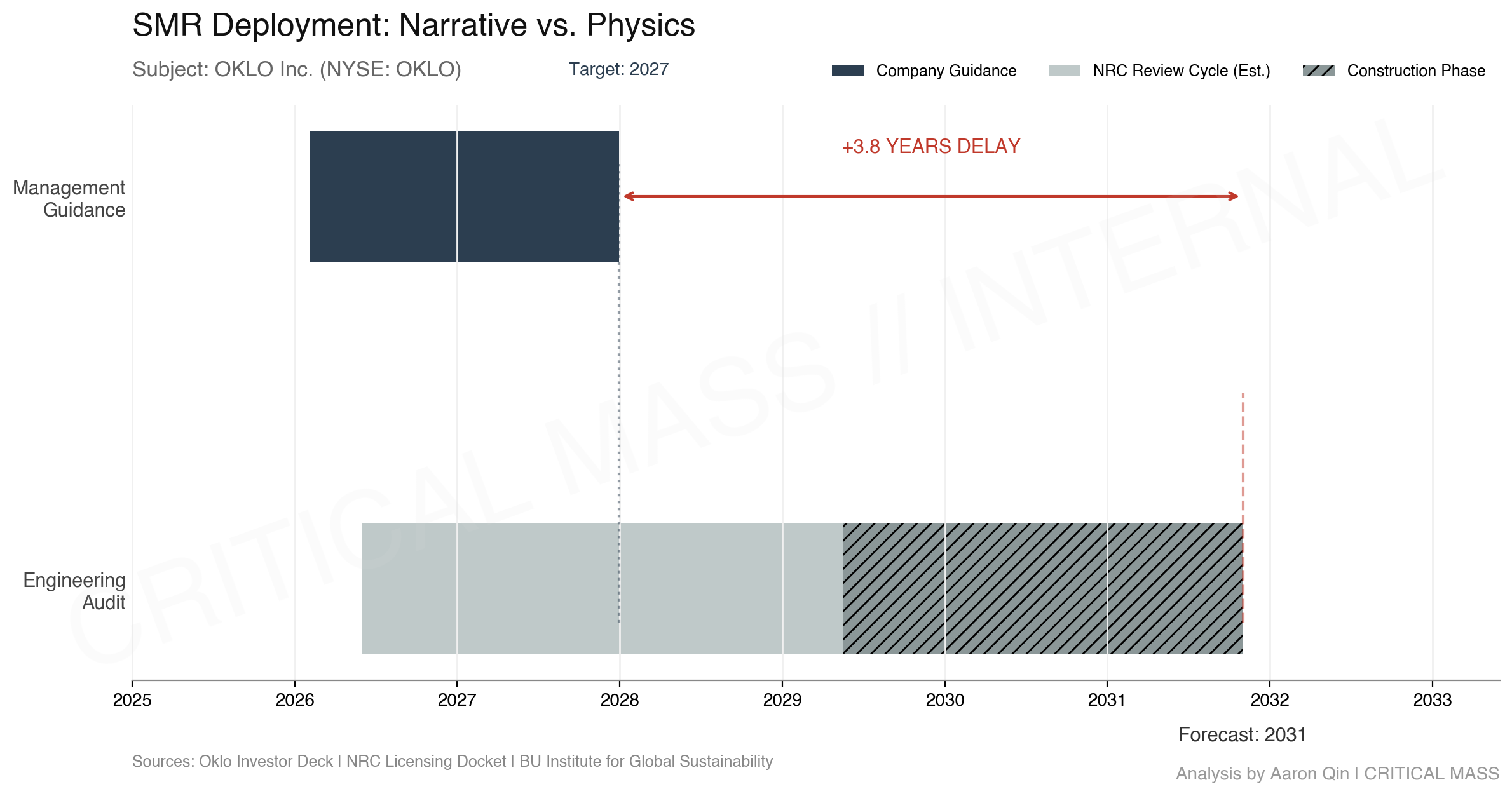
Using this timeline analysis, the path to grid connection is decomposed into three rigid, sequential phases:
Resubmission Preparation: Following the 2022 denial, the re-drafting of technical materials to meet NRC standards is expected to conclude no earlier than mid-2026.
NRC Review Cycle (36 Months): Even under the most optimistic policy-driven fast-track scenarios, a safety review for a novel reactor design requires a minimum of three years of administrative and technical verification.
Construction & Commissioning (30 Months): Civil works, core assembly, and non-nuclear system testing for a FOAK project have a rigid man-hour floor that cannot be bypassed by software-style "sprints."
(Visualization: Management Guidance vs. Engineering Reality)
Expand Briefing
Oklo Timeline GapFigure 1: Temporal divergence between management guidance (2027) and regulatory/construction realities (2032).
4. Scenario Check: Acceleration Variables
To maintain an objective posture, this note evaluates the levers Oklo might deploy to bridge this gap.
Acceleration Lever
Counterpoint
Assessment
Limited Work Authorization (LWA)
Oklo seeks LWA to start site prep early.
Allows 6–12 month overlap, but does not bypass core cold-testing. Gap remains ~3.2 years.
Policy Dividends (ADVANCE Act)
Legislation streamlines "red tape."
Laws cannot compress concrete curing or physical hardware verification. Safety auditing remains the bottleneck.
Pre-application Engagement
High-frequency interaction since 2022.
Historical FOAK construction encounters "field-change" orders that offset front-end administrative savings.
5. Financial Implications
Capital efficiency and economic drag.
From a capital efficiency standpoint, a delay of this magnitude fundamentally shifts the project's ROI profile.
Cash Flow Erosion: A 4.2-year delay implies nearly 50 months of additional "burn rate" without offsetting revenue. Every month of delay compounds the initial capital outlay while deferring the terminal value.
LCOE Deterioration: As investment costs accumulate and energy generation is pushed further into the future, the projected internal rate of return (IRR) is significantly compressed. By 2032, Aurora will face a more mature landscape of "Storage + Renewables" and potentially more advanced SMR competitors.
6. Conclusion
Current Assessment: High Timeline Risk
While this note recognizes the strategic importance of SMR technology in the AI era, it differentiates between technical potential and delivery reality.
On Oklo: A 2027 grid connection reads as physically unlikely in this model. This note treats 2027-2028 targets as "soft milestones" rather than operational certainties.
Related infrastructure: This note finds more logical convergence in the upstream nuclear fuel cycle (Uranium) and the physical grid infrastructure required to support these reactors.
Sources and notes
This note is anchored in verifiable, public-domain data:
NRC Regulatory Data: Notice of COL denial, Docket 52-049.
Government Records: DLA/DoD rescission notice regarding Eielson AFB.
Infrastructure Benchmarks: Boston University (IGS) study on nuclear infrastructure risk and project overruns.
Corporate Roadmap: Oklo Official Technology Disclosures.
Disclaimer
This piece reflects a personal analytical framework based on public information and systems-level reasoning. It is not investment advice.